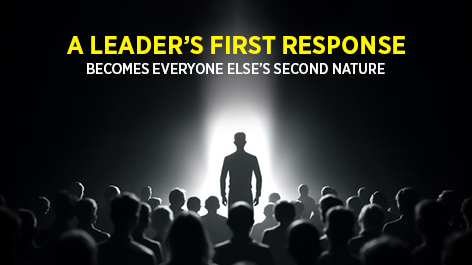
An organisation eventually begins to sound like its leader.
If the leader never admits uncertainty, everyone learns to hide uncertainty.
If the leader never acknowledges a mistake, everyone learns to defend theirs.
If the leader answers emails at midnight every day, people conclude that exhaustion is commitment.
If the leader never takes a holiday, everyone feels guilty for taking one.
If the leader apologises for leaving early to attend a family event, the organisation learns that life outside work requires an apology.
On the other hand, imagine a leader who begins a meeting by saying, “I changed my mind after reading your feedback.”
Imagine a leader who says, “I’m mentally exhausted today. Let’s postpone this decision until tomorrow because I want to give it my best thinking.”
Imagine a leader who laughs after making a mistake instead of pretending it never happened.
Imagine a leader who asks a young employee, “Can you teach me how this works? You understand it better than I do.”
None of these moments lowers authority.
They redefine it.
And that’s what human leadership is.
It is about refusing to perform superhumanity.
The moment a leader stops pretending to be invincible, everyone else stops pretending too and makes way for the honest cultures to be built.