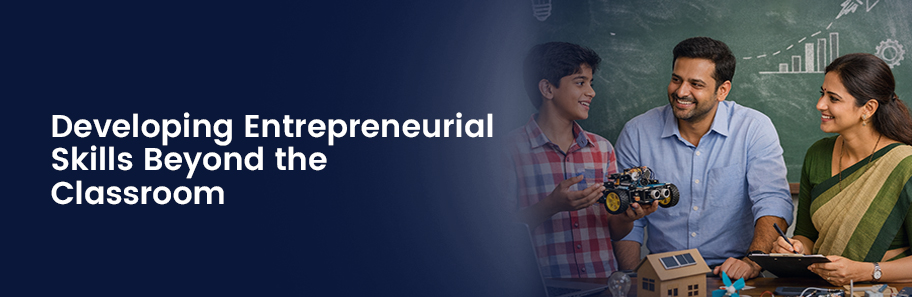
Developing Entrepreneurial Skills Beyond the Classroom
What if classrooms stopped pretending they were the real world? begin where certainty ends, where individuals wrestle with ideas, take risks, stumble, and uncover truths no textbook can teach.
In India, a nation building at scale and speed, education must act less like an instruction manual and more like a launchpad. When learning fuels initiative and courage, learners don’t just prepare for the future; they start shaping it.
Building the Entrepreneurial Mindset
Ideas don’t start with funding or formulas. Building the entrepreneurial mindset starts by learning to question assumptions, adapt quickly, and see opportunity where others see limits.
Nurturing curiosity, creativity, and confidence
Innovation waits for no one. Yet too many young minds are confined to theory, rarely tested by real challenges. Entrepreneurial skills beyond the classroom push learners to experiment, fail, and adapt.
Only when education dares to challenge routines and nurture resilience will we see a generation capable of shaping a complex, fast-changing society.
Understanding risk-taking and adaptability
True entrepreneurial skills are defined by the ability to take informed risks and adapt to change.
In India’s rapidly evolving economy, individuals who embrace uncertainty and create strategies thoughtfully are better prepared to innovate, lead responsibly, and contribute meaningfully to both local and global challenges.
How Education Should Progress in Practical Terms
Developing entrepreneurial skills requires that education break free from theory and embrace hands-on, practical experiences. The Times of India reported that actively engaged students retain up to 75% of knowledge, compared to just 10% through passive study.
The striking difference makes one thing clear: education that invites curiosity, dialogue, and hands-on engagement transforms knowledge into power.
Project-based learning, internships, and real-world problem-solving are not optional; they cultivate creativity, critical thinking, and initiative, empowering students to act decisively and make a meaningful impact in a rapidly evolving world.
Leadership Development in Students

Entrepreneurial skills beyond the classroom are essential for cultivating leadership. In India’s youth-driven landscape, learners who embrace uncertainty, initiative, and collaboration will define the country’s future.
Importance of Taking Initiative and Leading Teams
In a world that is changing faster than ever, leadership often begins with a simple choice: to step forward or stay comfortable.
Initiatives like the Viksit Bharat Buildathon invite individuals to take that step, confront real problems, make decisions under pressure, and discover the resilience, judgment, and confidence needed to lead teams in an increasingly complex future.
Building Communication and Decision-Making Abilities
Too often, learners know theory but struggle to express ideas or make choices under pressure. Real growth comes when they are challenged to debate, decide, and reflect.
Only then can education forge minds capable of clear thinking, confident action, and meaningful leadership.
Hands-on Learning Experiences
Entrepreneurial skills beyond the classroom take root when learners confront real challenges. Start-up incubators, rural projects, industry collaborations, and other aspects transform learning into leadership, shaping a generation ready to innovate and define India’s future.
Learning Through Innovation Labs and Competitions
Learners rarely learn by watching; they learn by doing. Innovation labs and competitions, supported by initiatives like the National Innovation Foundation (NIF), push them to experiment, confront failure, and solve real-world problems.
These experiences nurture critical thinking, resilience, and the confidence to turn ideas into meaningful action.
Internships and Real-World Problem-Solving
Too often, individual learning stops at theory, leaving potential untapped.
Programs like the Prime Minister’s Internship Scheme and Digital India Internship Scheme show what is possible when young minds engage with real problems, turning curiosity into capability and preparing India’s youth to lead in a complex and changing world.
Social Entrepreneurship and Community Projects
A top school in India doesn’t just teach; it challenges students to confront social issues, take initiative, and shape communities, turning learning into purposeful, real-world impact.
Using Entrepreneurship to Solve Community Problems
Real learning begins when students step outside familiar walls and confront problems that affect everyday lives. Entrepreneurship, in this sense, is not about ideas alone; it is about responsibility.
When young minds are encouraged to engage with communities, test solutions, and learn from failure, education gains purpose, and leadership takes root where it truly matters.
Inspiring Students to Create Social Impact
Social impact is no longer a local concern; it is a responsibility that resonates nationally and globally.
When students confront real challenges, like inequality, sustainability, and access, they learn to translate ideas into action, cultivating leadership that shapes society and contributes meaningfully to a world that requires conscience alongside competence.
Financial Awareness and Business Understanding

Entrepreneurial skills require more than ideas; they require financial awareness and business understanding. Students who master these tools can navigate markets, make informed decisions, and transform opportunity into lasting impact.
Basics of Budgeting, Pricing, and Investment
When students explore the basics of budgeting, pricing, and investment as practical tools that shape their decisions and future, they begin to understand the power and impact of money.
These fundamentals are essential. Without them, India risks a generation of talent unprepared to innovate or lead.
Teaching Financial Discipline and Smart Money Habits
When we teach financial discipline and smart money habits, we must ask: are students truly learning to value resources, or simply following instructions?
By offering practical workshops, real-life simulations, mentorship, and guided budgeting exercises, institutions can foster reflection, informed choices, and prudent money management. It helps shape foresight, responsibility, and decision-making essential for life beyond the classroom.
Handling Criticism and Feedback Effectively
How do individuals grow when every idea is critiqued on social media, in peer groups, or during high-stakes internships?
Those who approach criticism with calm and curiosity don’t just adapt. They learn to judge wisely, bounce back from setbacks, and lead with confidence, skills that will shape not only their future but our nation’s as well.
Building a Vision with Rhythm, Not Rigidity
Vision is not about holding fast to a plan; it is about listening to change, adjusting wisely, and acting decisively.
Individuals and institutions that embrace rhythm over rigidity turn uncertainty into opportunity, create lasting impact, and shape outcomes that matter in times of rapid change.
Conclusion
A top school in India cannot measure itself by results alone; it must dare to shape thinkers, leaders, and doers.
Education must challenge students, push them beyond comfort, and ask for engagement with the real world.
Only then does learning gain purpose. The vision is nurtured, skills are honed, and young minds emerge as responsible leaders who are ready to confront uncertainty, drive societal progress, and shape a future that requires courage, conscience, and action.


.png "Why Accessible Toilets Are Missing in Swachh Bharat?")
.png "Money Management Tips for Small Businesses to Grow")
.png "How to Navigate the Challenges of Scaling a Startup?")


